A complete architecture forenterprise AI
LimeOS is the operating system for applications built with AI.
LimeOS brings together several complementary technologies to build, deploy and run modern applications able to work with artificial intelligence and the real resources of the company.
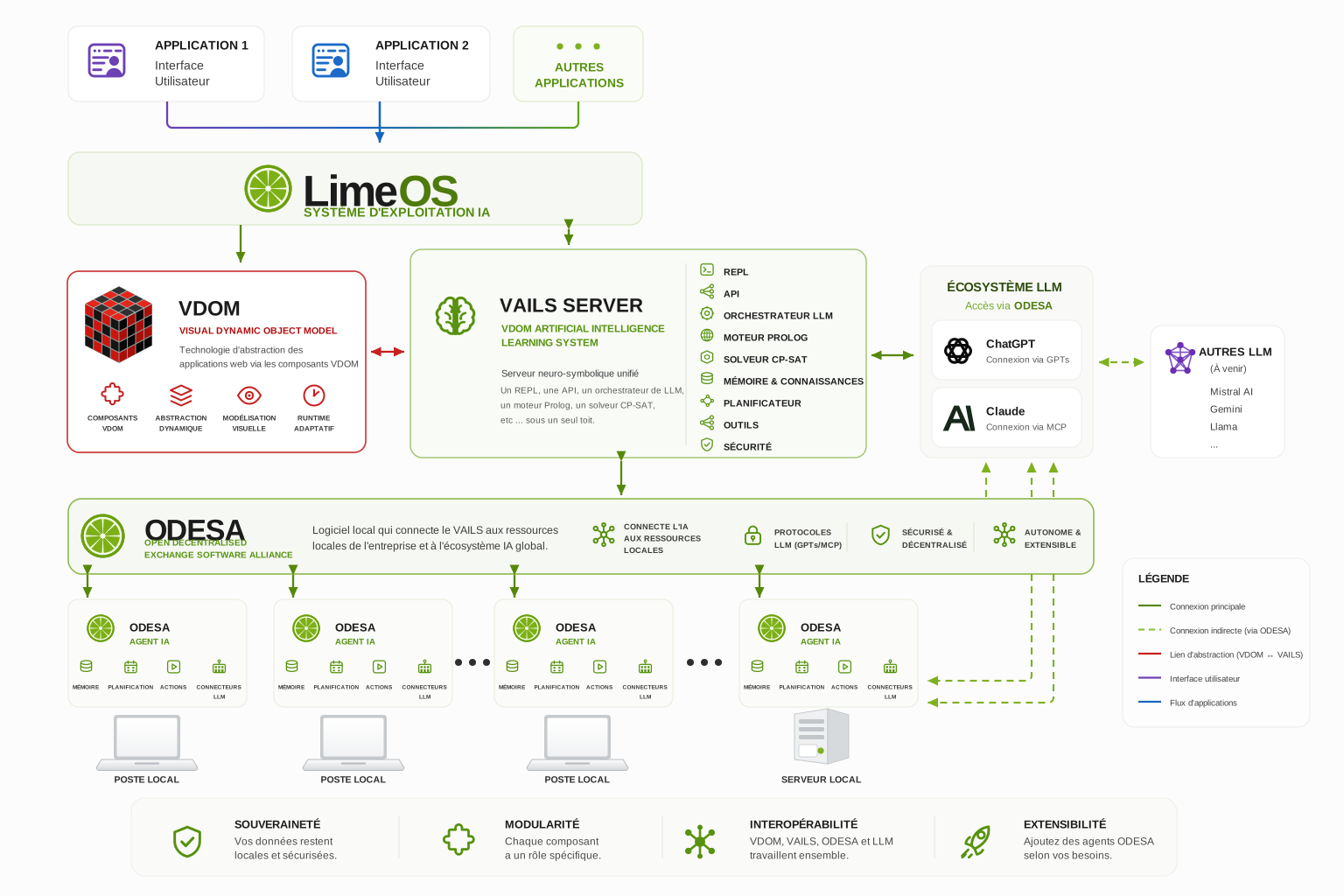
The architecture rests on four main building blocks: VDOM, VAILS, ODESA and the LLMs. Each has a precise role. Together they form an environment in which applications, artificial intelligence and the company's local systems can work coherently.
Applications, LimeOS, VDOM, VAILS, ODESA and LLM
The foundation of the ecosystem
LimeOS provides the shared environment in which applications are deployed, run and administered.
The goal is to let the creator focus on their application rather than rebuild, for every project, all the infrastructure required to operate it. A single LimeOS installation can therefore host many applications, whether developed traditionally or created with vibe coding tools.
LimeOS ensures consistency between the different building blocks of the ecosystem: application interface, business logic, artificial intelligence and local resources.
Abstracting the web application
VDOM — Visual Dynamic Object Model — is the LimeOS abstraction technology for web applications. Instead of building an application directly around the traditional mechanisms of the Web, VDOM lets you represent it through VDOM components.
These components are the functional and visual elements from which applications are built. This abstraction separates the definition of the application from many technical details tied to its execution.
VDOM abstracts the application. LimeOS provides its operating environment.
Learn more about VDOMThe neuro-symbolic server
VAILS — VDOM Artificial Intelligence Learning System — is the intelligent core of the architecture. VAILS is not merely a gateway to an LLM: it is a neuro-symbolic server bringing together several forms of computation and reasoning under one roof.
Learn more about VAILSThis architecture combines two worlds that are usually separate. On one side, LLMs bring language understanding, generation and probabilistic reasoning. On the other, symbolic engines bring logic, constraints, rules, structured knowledge and deterministic computation.
VAILS turns the LLM from a mere text generator into a component of a genuine reasoning system.
Connecting AI to the real world of the company
An AI server can reason. But to be genuinely useful to a company, it must also be able to reach its resources. That is the role of ODESA — Open Decentralised Exchange Software Alliance.
ODESA is local software installed on the company's computers and servers. It creates the link between VAILS and the local environment. Depending on the rights granted to it, ODESA lets the AI ecosystem interact with the resources available on the machine and in the company's environment: documents, business software, databases, applications, browsers, APIs, files or other local resources.
The AI is therefore no longer limited to what exists in its conversational context. It can work with the company's operational environment.
Learn more about ODESAA decentralised architecture
ODESA is not a single central agent. Each workstation can have its own ODESA and each instance stays autonomous: its own resources, permissions, memory, tools and ability to act. VAILS can orchestrate these different agents while preserving this distributed architecture.
This makes it possible to connect an entire company gradually — 1 workstation, 10, 100, several sites — without turning the whole into a monolithic architecture.
ChatGPT and Claude become entry points
An important aspect of ODESA is that the connection also works the other way round. The LimeOS ecosystem does not force a proprietary conversational interface on the user to reach their intelligence.
ODESA implements the protocols needed to communicate with ChatGPT through GPTs and with Claude through MCP. Users can therefore stay in their usual conversational environment and query the company's ecosystem from there. A conversation with an LLM becomes a controlled gateway to the company's digital capabilities.
LLMs remain interchangeable
The architecture is not built around one particular language model. VAILS orchestrates the models while ODESA provides the interconnection mechanisms required. The ecosystem can therefore evolve along with the available models.
ChatGPT, Claude or other LLMs can serve different functions depending on the need: understanding, reasoning, generation, analysis or tool use. This separation avoids making the whole architecture depend on a single artificial intelligence provider.
Each block, one role.
And LimeOS assembles and operates the whole to provide a coherent environment for applications.
Two continuities, one ecosystem
A LimeOS application can ask VAILS to solve a problem. VAILS can combine an LLM, Prolog rules, CP-SAT constraints, its memory and various tools to determine what should be done. When a piece of information or an action lies in the company's local environment, ODESA makes it possible to reach the resource concerned.
Conversely, a user can start from ChatGPT or Claude, go through ODESA and query the capabilities made available by the ecosystem.
An AI that no longer stays locked inside the chat.
Moving artificial intelligence from the status of a conversational tool to that of genuine application infrastructure for the company.
- —LLMsbring linguistic intelligence.
- —VAILSbrings structure, logic and orchestration.
- —ODESAbrings access to the field.
- —VDOMbrings application abstraction.
- —LimeOSprovides the foundation that makes all of this usable.
LimeOS is not simply trying to put AI into applications. It provides the architecture that lets applications, AI and company resources work together.